
Infection prevention and Linen Management – What Every Long-Term Care Facility Needs to Know
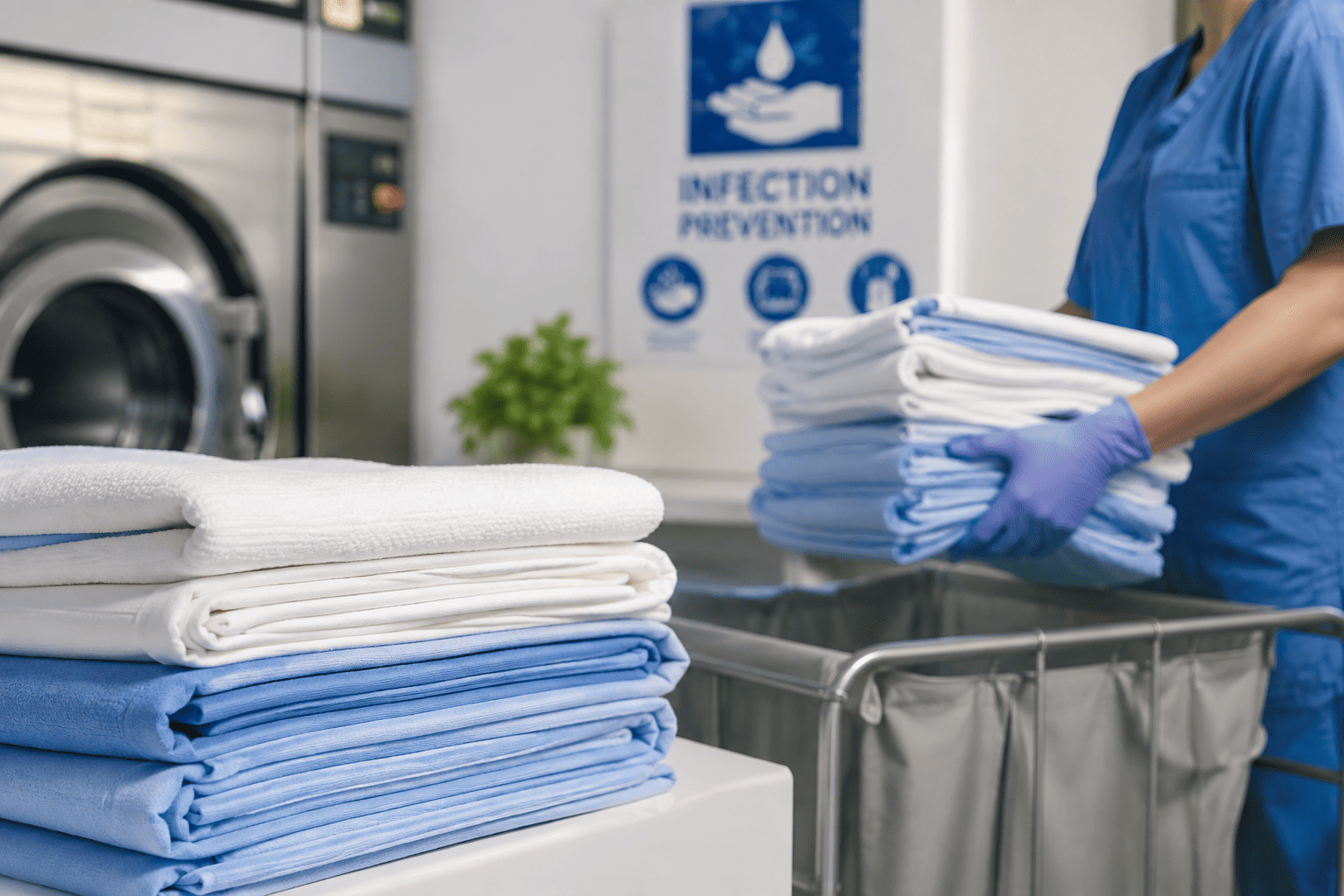
Most long-term care facility administrators have a detailed infection prevention program. Hand hygiene protocols. PPE policies. Isolation procedures. Surveillance systems.
And then there are the linens.
Sheets changed twice a week. Scrubs worn across multiple units. Gowns laundered by a vendor whose processing standards nobody has verified in two years. Soiled linen carts parked in the hallway between resident rooms because the storage room is full.
None of these are intentional failures. They are the quiet gaps that accumulate in facilities where linen is treated as a housekeeping function rather than an infection prevention function. The research is unambiguous. According to Infection Control Today, healthcare textiles are an underrecognized vector for pathogen transmission — including MRSA, C. difficile, VRE, and other multidrug-resistant organisms that are among the most dangerous threats facing long-term care residents today. And the standards governing how those textiles are handled, processed, and delivered are more specific — and more enforceable — than most facility leaders realize.
This guide covers what the regulations actually require, what hygienically clean linen actually means, and what the difference between an accredited and non-accredited linen partner actually costs a facility when an infection survey comes around.
Key Facts:
- According to the CDC, approximately 1 in 31 hospital patients has at least one healthcare-associated infection on any given day
- CMS regulations for long-term care facilities specifically address the appropriate handling, processing, and storage of linens as a required component of infection prevention programs
- The Joint Commission updated infection prevention standards effective July 1, 2024 — aligning requirements with CMS guidelines
- HLAC accreditation requires compliance with standards developed in collaboration with the CDC and involves rigorous independent on-site inspections
- According to Infection Control Today, healthcare linen is an underrecognized risk in infection prevention and control
Why Linen Is an Infection Prevention Issue — Not a Housekeeping Issue
The distinction matters more than it sounds.
When linen is managed as a housekeeping function — it gets evaluated on cost, turnaround time, and whether residents complain about scratchy sheets. When it is managed as an infection prevention function — it gets evaluated on pathogen reduction, processing validation, chain of custody from soiled collection to clean delivery, and staff handling protocols.
The gap between those two evaluation frameworks is where HAIs happen.
Contaminated textiles can harbor pathogens for hours to days depending on the organism and the fabric type. According to the CDC's Guidelines for Environmental Infection Control, soiled linen handled without proper containment and processing poses a documented transmission risk for healthcare-associated pathogens including MRSA and C. difficile. Soiled linen handled without proper PPE exposes staff to bloodborne pathogens and MDRO transmission. Clean linen stored improperly or transported in contaminated vehicles can be re-contaminated before it ever reaches a resident's bed.
This is not a theoretical risk. It is a documented, regulated, inspectable risk — and the facilities that treat it as such have measurably better infection outcomes.
What CMS Actually Requires for Linen in Long-Term Care
CMS requirements for linen handling in long-term care are not suggestions. They are conditions of participation — meaning non-compliance can directly affect Medicare and Medicaid reimbursement.
According to the SHEA/APIC Guideline on Infection Prevention and Control in Long-Term Care published in PMC:
"CMS has published requirements for LTCFs that apply to facilities accepting Medicare and/or Medicaid residents. CMS regulations address the need for a comprehensive infection prevention program that includes appropriate handling, processing, and storage of linens."
In practical terms, CMS surveyors evaluating a long-term care facility's infection prevention program will look at:
Soiled Linen Handling
Is soiled linen collected and contained immediately — or left on surfaces, floors, or open carts where airborne dispersal can contaminate the surrounding environment? CMS expects facilities to have written protocols for soiled linen collection — and staff who can demonstrate those protocols on request.
Storage Separation
Clean and soiled linen must be stored and transported separately. In facilities where storage space is limited — this separation breaks down. A surveyor who finds clean linen stored adjacent to soiled collection areas or transport equipment has found a deficiency.
Processing Standards
CMS does not specify exact washing temperatures but requires that linen processing achieves hygienically clean results. Facilities that outsource linen processing are responsible for verifying that their vendor meets this standard. A contract with a non-accredited laundry is not a defense in a survey.
Staff Training
Staff who handle soiled linen must be trained in appropriate PPE use, hand hygiene after linen handling, and the facility's specific collection and storage protocols. This training must be documented.
According to Infection Control Today's 2024 coverage of updated CMS nursing home guidance, effective April 1, 2024, long-term care surveyors began evaluating enhanced barrier precautions under CMS Memo QSO-24-08-NH — making the current survey environment significantly more rigorous than it was before.
What the Joint Commission Requires for Linen
For facilities seeking or maintaining Joint Commission accreditation — the linen-related standards are equally specific.
According to a ScienceDirect analysis of Joint Commission linen standards:
"Standard IC.4.3 states: 'Staff members handle, store, process, and transport linens so as to prevent the spread of infection.' Personal protective equipment should be used by laundry personnel."
NETEC's comprehensive guide to the 2024 Joint Commission infection control update confirms that the standards effective July 1, 2024, consolidated from 12 standards with 51 elements to 4 standards with 14 elements — prioritizing essential infection prevention measures and explicitly aligning language with CMS guidelines.
The practical implications for long-term care facilities are significant. Standard IC.4.3 does not simply require that linen gets washed. It requires that every stage of the linen lifecycle — collection, transport, processing, packaging, storage, and delivery — is managed in a way that actively prevents infection spread.
Research published in ScienceDirect by Schmaltz, Longo, and Williams in 2024 found that Joint Commission-accredited long-term care hospitals had significantly better standardized infection ratios for CLABSI and CAUTI measures compared to non-accredited facilities — suggesting that the operational disciplines enforced by Joint Commission standards produce measurable infection outcomes.
The connection between accreditation standards and actual infection rates is not coincidental. It reflects the cumulative effect of every operational detail — including linen management — being held to a documented inspected standard.
What Hygienically Clean Linen Actually Means
This term appears throughout healthcare linen regulation and accreditation standards — and it means something very specific. It is not the same as clean. It is not the same as visually acceptable. And it is not achievable with a standard commercial laundry process.
According to the Healthcare Laundry Accreditation Council, hygienically clean requires the effective removal of all biological contaminants — bioburdens — through a validated combination of four elements working in concert:
Thermal Disinfection — Temperature
Water temperature sufficient to kill pathogens must be maintained throughout wash and rinse cycles. The specific requirements depend on the chemical formulation used — but the combination of temperature and contact time must achieve validated pathogen reduction through calibrated equipment, documented process controls, and regular validation testing.
Chemical Action — Formulation and Dosing
According to the CDC's Guidelines for Environmental Infection Control, proper laundry processing is critical to preventing healthcare-associated infections — with specific requirements for temperature, detergent selection, and physical plant design all working together.
The chemistry used in healthcare linen processing must be formulated and dosed to achieve specific pathogen reduction in combination with the temperature and mechanical parameters of each wash cycle. HLAC accreditation requires validation that chemical protocols are consistently achieving intended results — not just that the right products are being used.
Mechanical Action — Agitation and Cycle Design
The physical action of the wash cycle must be sufficient to dislodge and remove bioburden from fabric. Cycle time, drum speed, and water volume all affect mechanical action — and all are specified in validated processing protocols at accredited facilities.
Proper Handling After Processing
A linen that leaves a processing facility in a hygienically clean state can be re-contaminated by improper handling before it ever reaches the patient. According to the HLAC accreditation standards, clean linen must be packaged, transported, and stored in ways that maintain its hygienically clean status from the processing facility all the way to the point of use.
The chain of custody matters as much as the wash process. Hygienically clean linen delivered in an open cart that traveled alongside soiled returns is not hygienically clean when it arrives.
Is Your Linen Management Program Meeting Current Infection Prevention Standards?
Healthcare Linen Services Group operates HLAC-accredited processing facilities serving long-term care facilities, hospitals, and healthcare institutions throughout the Midwest and beyond. We provide full documentation of our infection prevention compliance — so your facility is never without the evidence it needs when a surveyor asks.
Call HLSG — (888) 873-4740
Contact Us for a Facility Assessment